UX Case Study  ·  Fintech  ·  2023 – 2024 UX 案例  ·  金融科技  ·  2023 – 2024

TikTok
PayLater

End-to-end UX design for TikTok's Buy Now Pay Later product in Indonesia — credit application, account management, and repayment — from first sketch to launch.

TikTok 印尼先买后付产品的全链路 UX 设计,覆盖授信、账户管理与还款流程,从零到上线独立完成。

Role
角色
Sole UX Designer
独立 UX 设计师
Market
市场
Indonesia
Platform
平台
TikTok Shop
Launch
上线
July 2024
Scroll to explore向下滚动
Overview
项目概览

BNPL for social commerce, in one of SE Asia's fastest-growing markets

社交电商里的先买后付,印尼这个东南亚最大市场

TikTok entered Indonesia's consumer finance market through a strategic partnership with GoTo / Tokopedia, embedding GoPay Later into TikTok Shop to form ShopTokopedia.

TikTok 通过与 GoTo / Tokopedia 的战略合作进入印尼消费金融市场,将 GoPay Later 嵌入 TikTok Shop,形成 ShopTokopedia。

Partnership structure: TikTok does not hold a financial services license in Indonesia. GoPay Later (GoTo Financial) provides the BNPL infrastructure and OJK regulatory compliance, while I owned the complete user experience layer within TikTok Shop.

合作结构:TikTok 在印尼不直接持有金融牌照。GoPay Later(GoTo Financial)提供 BNPL 基础设施和 OJK 监管合规,我负责 TikTok Shop 内的完整用户体验层。

Project Brief
项目 Brief
Goal 目标

Turn TikTok's first BNPL experience into something that feels official, trustworthy, and actually finishable inside a high-distraction commerce app.

把 TikTok 首次上线的 BNPL 体验,做成一个在高干扰电商场景里也依然可信、清晰、可完成的金融流程。

What I Owned 负责范围

End-to-end UX across credit application, account & billing, and repayment, including first-time activation and return-user service flows.

负责授信申请、账户账单、还款三条主链路的端到端 UX,也覆盖首次开通与回访用户的服务流程。

Design Constraint 设计约束

The experience lived in TikTok Shop, but key moments depended on partner infrastructure, third-party KYC, and external payment-channel handoffs.

体验发生在 TikTok Shop 内,但关键节点必须依赖合作方基础设施、第三方 KYC,以及外部支付渠道跳转来完成。

As the sole UX designer, I designed every user-facing interaction from scratch. Our user research team conducted on-site interviews in Indonesia — I collaborated closely with them remotely, synthesizing findings into design decisions in real time.

作为唯一一名 UX 设计师,我从零开始设计了所有面向用户的交互。用研同事前往印尼进行实地访谈,我在线上密切配合,实时将调研发现转化为设计决策。

3

Core flows designed

核心流程

Credit application, account & billing, repayment — all from zero.

授信申请、账户账单、还款,全部从零设计。

6

Competitors analyzed

竞品分析

6 benchmark journeys across onboarding, KYC, and repayment patterns.

围绕开通、KYC 与还款模式,系统对比 6 个样本。

6

UX risks surfaced

体验风险识别

Proactively identified pre-launch, with owners and mitigation plans.

上线前主动识别,每条风险均有负责人和后续计划。

Research
研究阶段

On-the-ground research in Indonesia

深入印尼的实地调研

I paired Indonesia field interviews with a 6-product BNPL benchmark to pinpoint where trust forms, where compliance starts to feel heavy, and where drop-off risk rises.

我把印尼实地访谈与 6 款 BNPL 竞品走查结合起来,重点定位用户在哪些环节建立信任、在哪些环节开始感到负担,以及最容易流失的位置。

Competitive Landscape

竞品全景

Full benchmark set
完整 Benchmark

6 products benchmarked, then reorganized into one comparison board.

6 款产品完成走查,再重组为同一张对比板。

6 Products
mapped
产品坐标
2 Comparison
axes
比较维度
3 Core
flows
核心流程
Competitive landscape
竞品矩阵
All 6 products in the benchmark set
完整 6 个 Benchmark 样本
Account-level repayment 账户维度还款
Shopee Shopee PayLater
GoTo GoPay Later
Lazada LazPayLater
Grab GrabPayLater
Akulaku Akulaku
PH ref Moca Moca (PH)
Product 产品
Model 类型
Where it stands out 问题 / 机会最明显的环节
Observed in source 原始观察
What I took from it 设计提炼
Shopee PayLater
E-commerce native
电商自营
Entry入口
Verify核验
Setup设置
Repay还款
Trust-led entry with visible progress
以品牌信任进入,并用进度包装降低压力
i

Brand familiarity reduces hesitation at entry, and the step-based packaging lets users feel progress before they see the full form burden.

品牌熟悉度能降低用户在入口处的犹豫,步骤化包装则让用户先感受到进度,再看到完整表单负担。

Visible steps soften the perceived field load.
连续步骤会弱化用户对字段负担的感知。

Users see progress before they see the full form.

用户先看到进度,再看到完整表单。

Lead with trust and progress, not raw complexity.
先给信任和进度感,再暴露复杂度。

A useful reference for TikTok PayLater onboarding.

这是 TikTok PayLater 开通页的重要参考。

GoPay Later
Standalone fintech
独立金融品牌
Entry入口
Verify核验
Setup设置
Repay还款
Complete verification, but later recall risk
核验完整,但后期存在记忆回调风险
i

The KYC chain is thorough, but repayment later still depends on PIN recall. The raw notes also flagged password recovery as a later support risk.

这条 KYC 链路很完整,但后期还款依然依赖 PIN 记忆。原始备注里也特别提到,忘密与找回会成为后续风险。

KYC is complete, but repayment still relies on PIN recall.
KYC 覆盖完整,但后期还款仍依赖 PIN 记忆。

Password recovery becomes a later risk.

忘密与找回会在后期变成风险。

Continuity after activation matters as much as KYC completion.
开通后的连续体验和 KYC 完整度同样重要。

This reinforced the need for resume-after-interruption.

这也强化了“断点继续”必须成为主流程。

LazPayLater
E-commerce native
电商自营
Entry入口
Verify核验
Setup设置
Repay还款
Checkout-context entry lowers switching cost
结账场景进入,先降低正式开通前的切换成本
i

Activation starts from checkout instead of a standalone credit page, so the first step feels tied to the purchase task rather than a separate financial process.

它的开通不是从独立授信页开始,而是发生在结账场景里,所以第一步更像购买任务的延续,而不是额外插入的一套金融流程。

Activation starts from checkout, not a standalone credit page.
开通从结账场景开始,而不是独立授信页。

The first step feels tied to the purchase task.

用户更容易把第一步理解为购买任务的一部分。

Entry context can lower switching cost before KYC begins.
入口场景本身就能降低正式 KYC 前的切换成本。

I treated entry design as part of onboarding design.

因此我把入口也视作开通体验的一部分。

Akulaku
Standalone BNPL
独立 BNPL 品牌
Entry入口
Verify核验
Setup设置
Repay还款
Verification burden spikes with low-value fields
核验阶段因低价值字段而明显增重
i

The form asks for blood type, work history, and number of children. These fields were explicitly called out in the raw notes as information that felt excessive.

表单会收集血型、工作经历和子女数量等信息。这些字段在原始备注里被直接点名,属于让用户明显感到“收得太多”的内容。

The form asks for blood type, work history, and number of children.
表单会收集血型、工作经历和子女数量等信息。

These were explicitly called out as excessive.

这些字段在原始备注里被明确指出过重。

If field necessity is unclear, compliance becomes friction fast.
一旦字段必要性不清晰,合规很快就会变成摩擦。

That set a stricter rule for TikTok PayLater fields.

这也让 TikTok PayLater 对字段取舍更严格。

GrabPayLater
Super app native
超级 App 自营
Entry入口
Verify核验
Setup设置
Repay还款
Setup cost accumulates after verification
核验之后,账户设置成本继续叠加
i

OTP, card binding, PIN, and email confirmation are each manageable on their own, but together they still create a long setup chain before users see value.

OTP、绑卡、PIN 和邮箱确认单看都不算重,但叠加后仍会形成一条很长的账户准备链路,用户在看到价值前要先完成大量设置动作。

OTP, card binding, PIN, and email confirmation stack up.
OTP、绑卡、PIN 和邮箱确认会叠加在一起。

Each step is manageable, but the total setup cost is still high.

单步不重,但总准备成本依然很高。

Smaller steps do not automatically make a flow feel light.
拆成小步骤,并不自动等于“轻”。

Fragmentation helps readability, not total cost.

它改善的是可读性,不是用户总成本。

Moca Moca (PH)
Regional repayment reference
区域还款参考样本
Entry入口
Verify核验
Setup设置
Repay还款
Useful mainly as a repayment-sequence reference
主要用于参考还款链路的顺序组织
i

This Philippines sample was useful mainly for comparing how repayment steps were sequenced and packaged, rather than for carrying over the same brand-trust context.

这个菲律宾样本的主要价值,是用来比较还款步骤如何被排序与打包,而不是直接迁移相同的品牌信任语境。

Used as a Philippines repayment sequence reference.
它被用作菲律宾市场的还款顺序参考。

The value here is structure, not brand carry-over.

它的价值在结构,不在品牌迁移。

A useful sequence reference without forcing the same trust context.
即使不共享同一信任语境,它依然可以作为顺序参考。

I used it to compare packaging and sequence only.

因此我只拿它来比较打包方式和顺序。

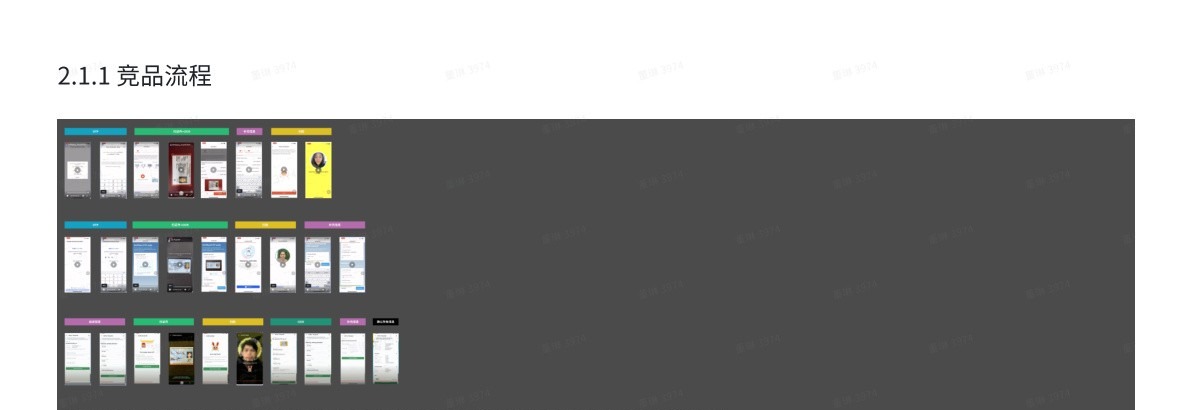
Raw Research Evidence 原始调研材料

Competitive flow audit board

竞品流程拆解总板

Original competitor research board cropped to keep the relevant benchmark flows only
Cropped from the working board used during the benchmark study, keeping only the flow sets referenced in this case study.
从竞品调研工作板中裁剪,仅保留本案例中引用的流程拆解部分。

Key Insights from User Interviews

用户访谈核心洞察

  • 01
    Brand trust determines adoption. 品牌信任是开通意愿的决定性因素。 Users showed significantly higher willingness to apply when BNPL was positioned as the platform's own product. TikTok's existing brand credibility was an asset to design around. 当 BNPL 以平台自有品牌呈现时,用户开通意愿显著提升。TikTok 的品牌信任度是可以被设计利用的资产。
  • 02
    Form length is the primary conversion killer. 表单长度是转化率的主要杀手。 Users recalled abandoning previous BNPL applications when forms felt intrusive — blood type, work history, number of children. 用户反映曾因表单过于繁琐而放弃申请,如血型、工作经历、子女数量等信息让他们感到不适。
  • 03
    PIN forgetting is a latent support burden. PIN 遗忘是潜在的客诉定时炸弹。 Users set a PIN once at onboarding and rarely use it. Many forget it by the time a payment is due — and the recovery flow is complex. 用户只在开通时设置一次 PIN,此后鲜少使用,到真正需要还款时往往已遗忘,而找回流程又相当复杂。
  • 04
    Phone number recycling is a uniquely SE Asian problem. 手机号二次放号是东南亚特有问题。 Secondary SIM usage is widespread in Indonesia. Abandoned numbers tied to PayLater accounts create dispute and fraud vectors that don't exist in stable-number markets. 印尼二次放号现象普遍,绑定 PayLater 账户的手机号一旦被弃用,既无法被原主人修改,也无法被新持有人使用,极易产生纠纷和客诉。
Design
设计方案

Three hard problems — and how I approached them

三个核心设计挑战

"How do you convert a high-friction financial onboarding inside an entertainment app?"
"如何在一款娱乐 App 里,完成一个高摩擦的金融开通流程?"

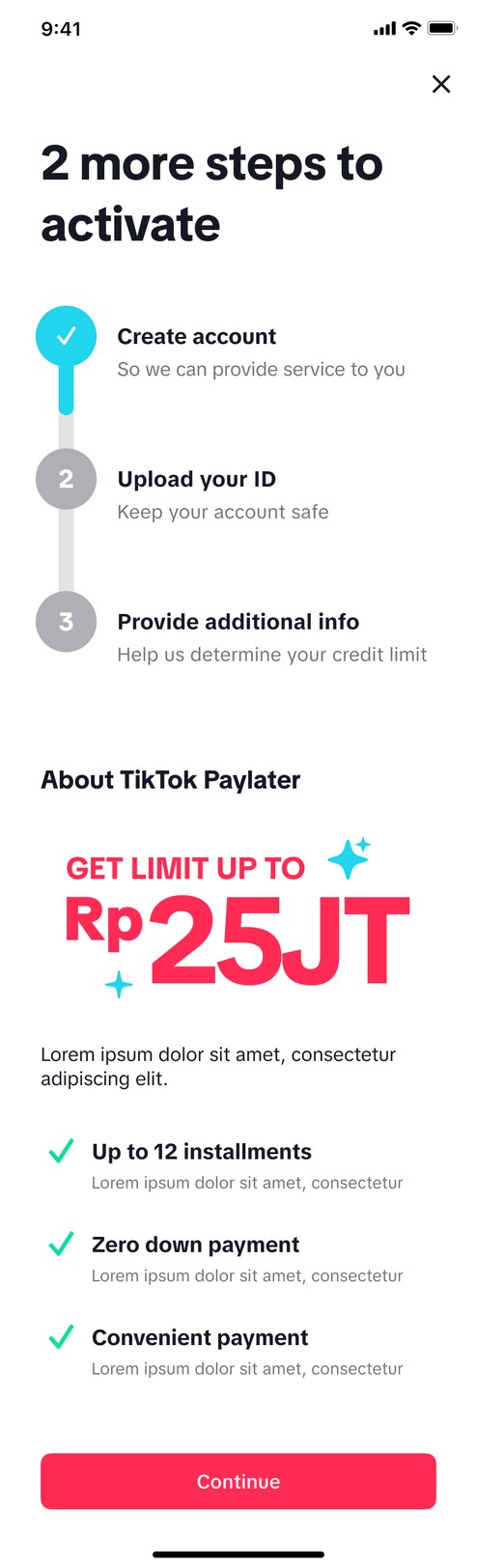
01 — Credit Application: taming a long flow

01 — 授信流程:驯服一个超长链路

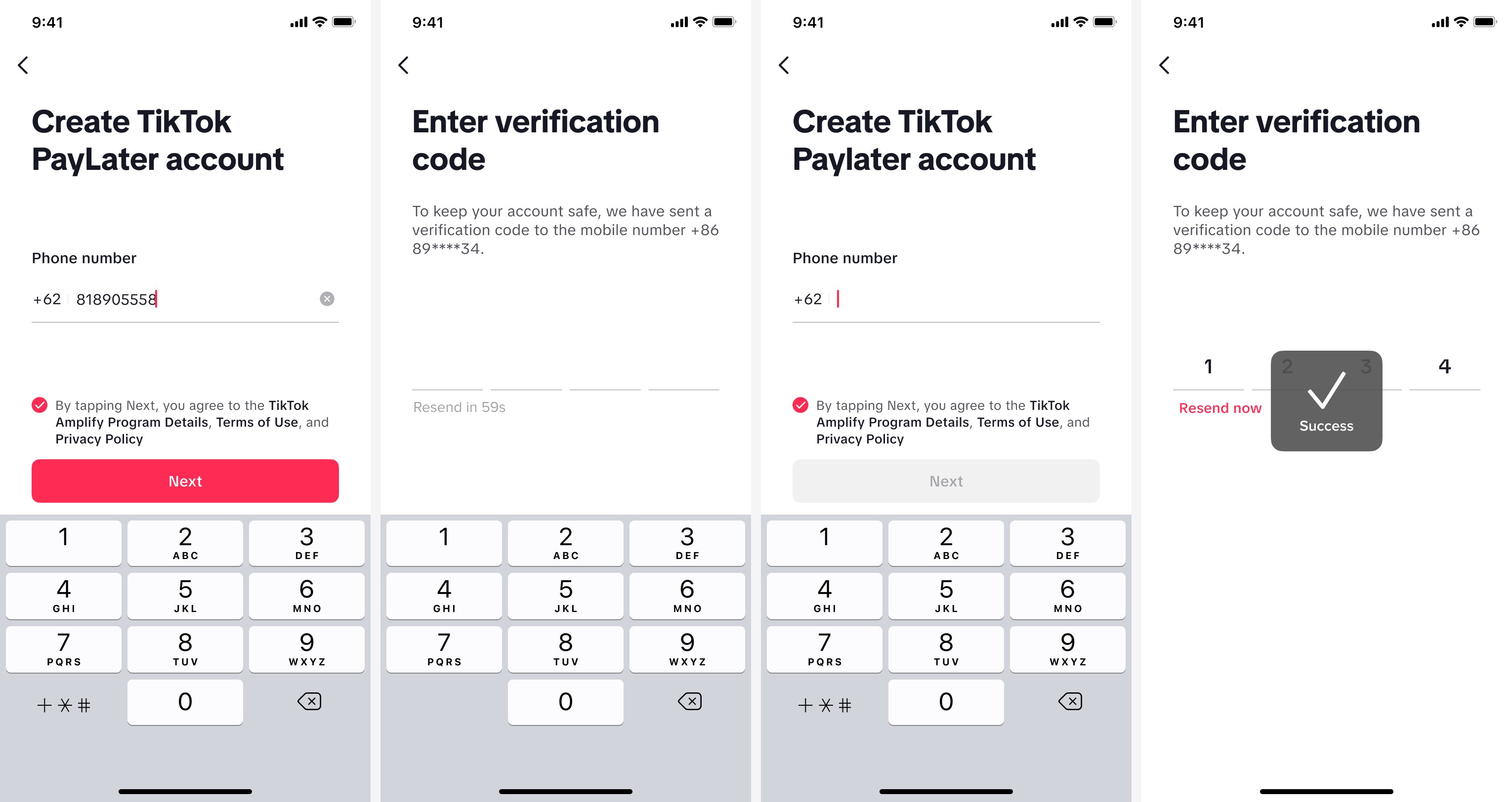
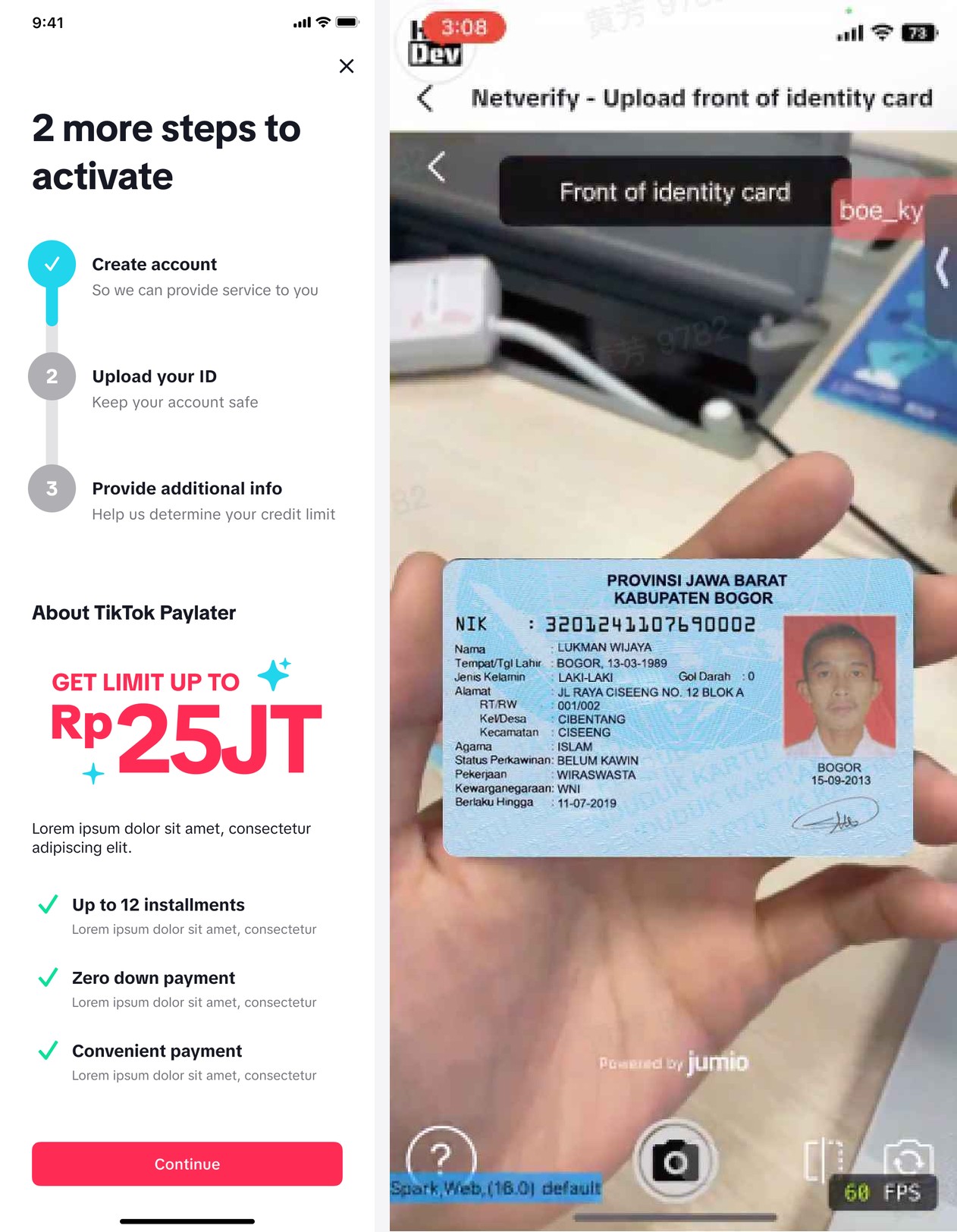
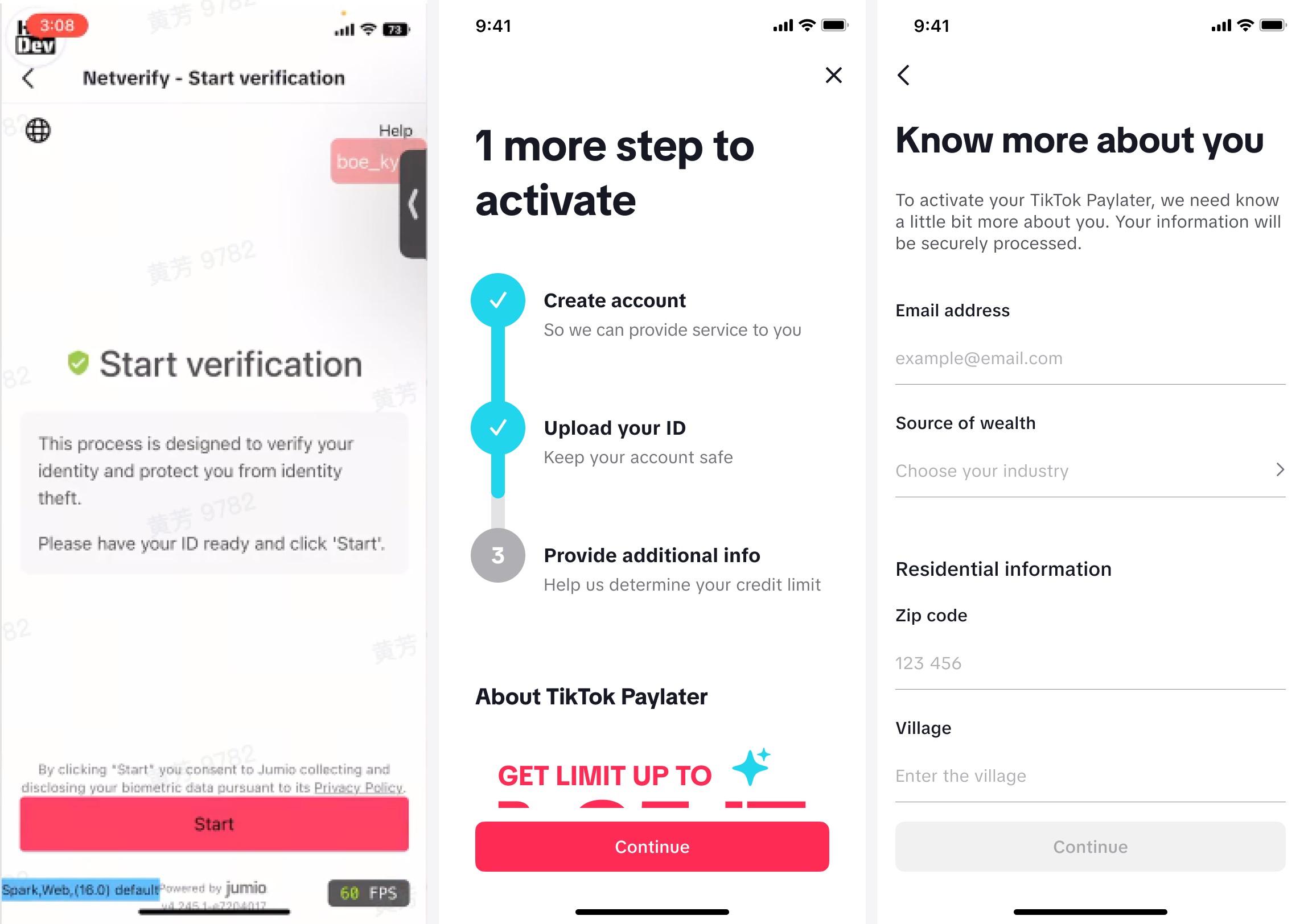
The full credit flow requires: phone verification → ID document scan (Jumio) → facial recognition → personal info form → repayment date selection. A 7–8 step journey competing with every distraction TikTok is designed to offer.

完整授信流程涵盖:手机号验证 → 证件扫描(Jumio)→ 人脸识别 → 个人信息填写 → 还款日设置。 7-8 步的超长链路,还要跟 TikTok 平台本身所有令人分心的内容竞争用户注意力。

Decision: restructure into 3 progressive tasks, each with a completion reward.

设计决策:将流程拆成由易到难的 3 个任务,每完成一个给予用户一次激励反馈。

TikTok PayLater activation flow merged with the 3-task architecture overview TikTok PayLater 授信流程合成图,顶部整合三任务架构信息

Just as important, resume after interruption was designed as a primary path, not an edge case. Because the activation journey is long and repeatedly depends on partner capabilities, users are highly likely to pause, hand off to another system, or drop temporarily. That made the landing page responsible for more than entry navigation: it had to remember progress, identify the unfinished task, and bring users back into the flow from the exact point where they stopped (shown left).

同样关键的是,我把中断后继续完成当作主流程来设计,而不是边缘 case。 由于整条开通链路很长,而且多个关键节点都依赖合作方能力,用户很容易中途暂停、跳转到外部环节,或暂时离开。 这意味着 Landing page 不能只承担入口作用,它还必须负责“记住进度、识别未完成任务,并把用户准确带回中断位置”(见左侧 Landing 页)。

Why progressive tasks work: Milestone framing ("complete 3 tasks") consistently outperforms indeterminate form framing. Each completion event provides a moment of positive reinforcement, reducing abandonment between steps.

为什么任务分段有效:里程碑式的框架("完成 3 个任务")在转化率上持续优于不定长的表单形式。每个任务完成都提供一次正向激励,有效降低中途放弃率。

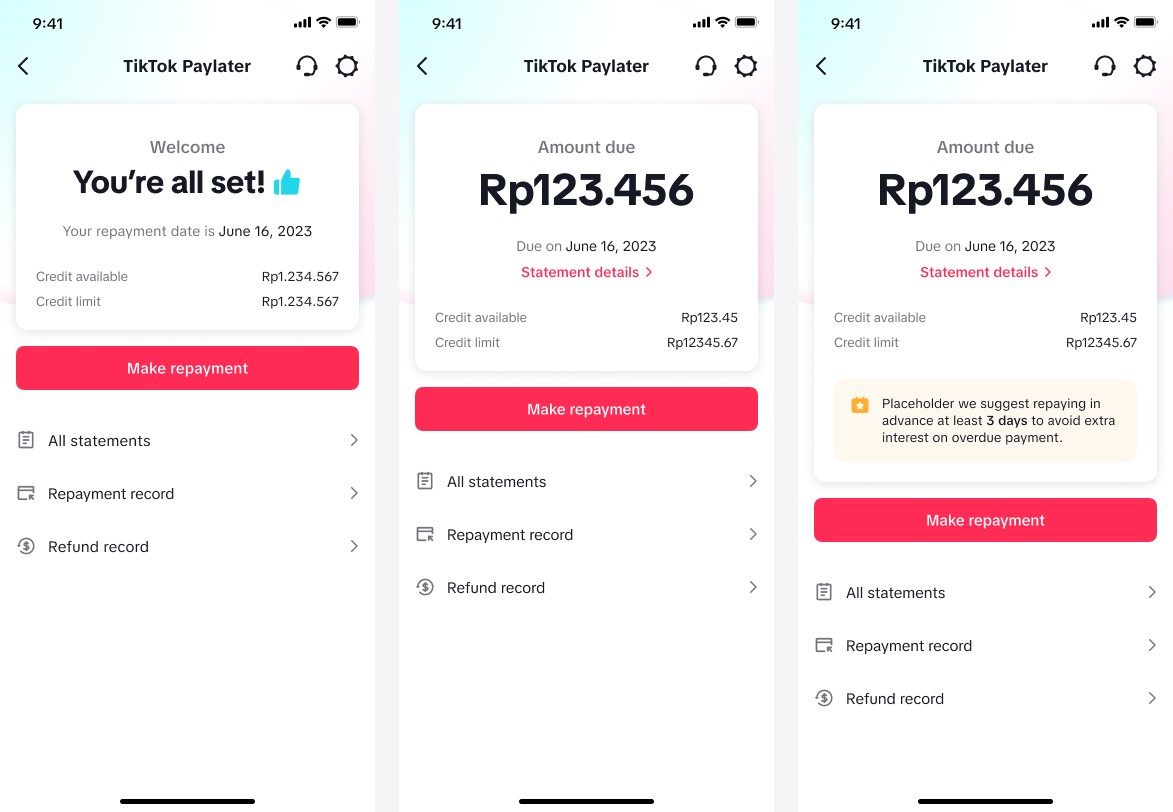
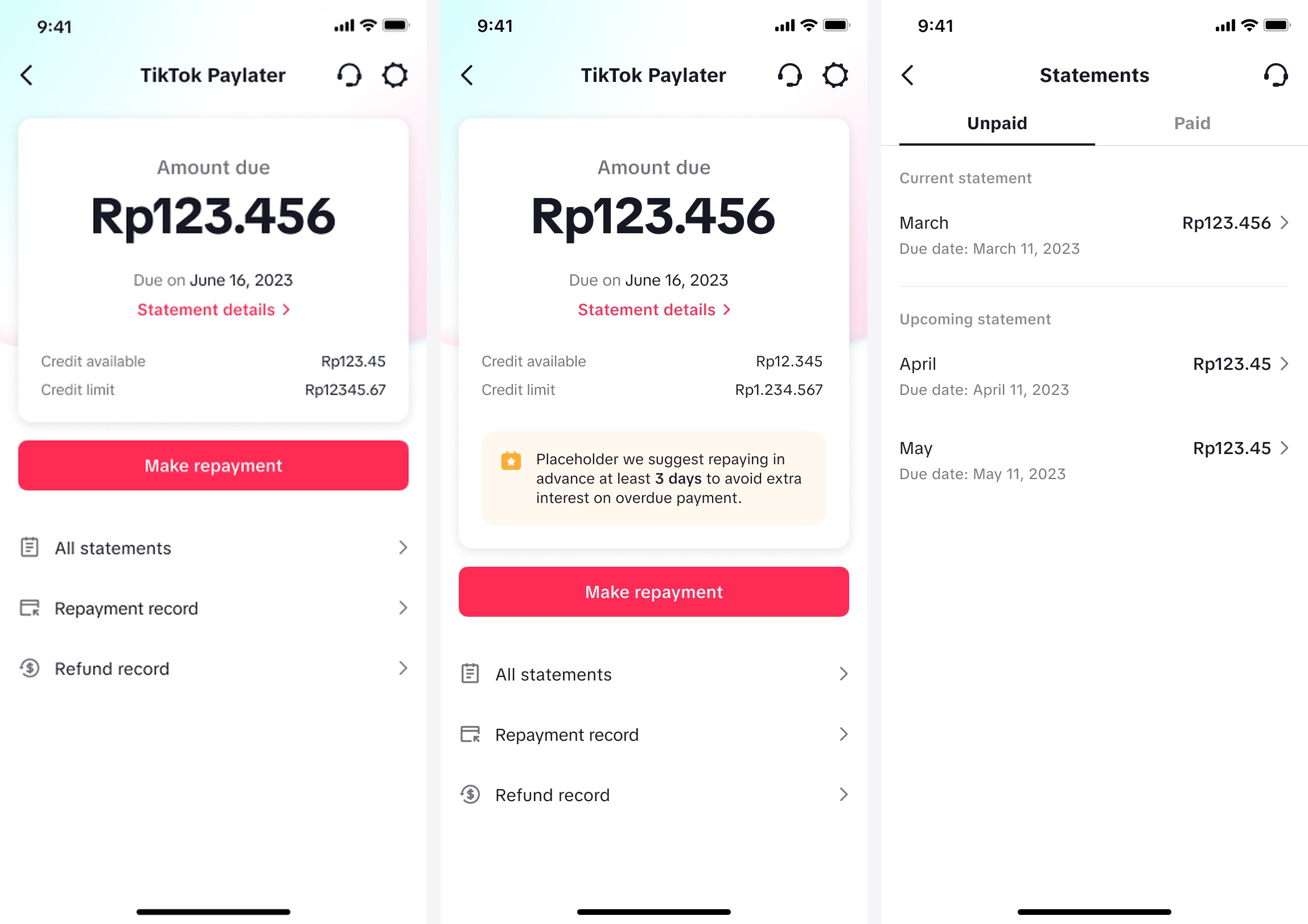
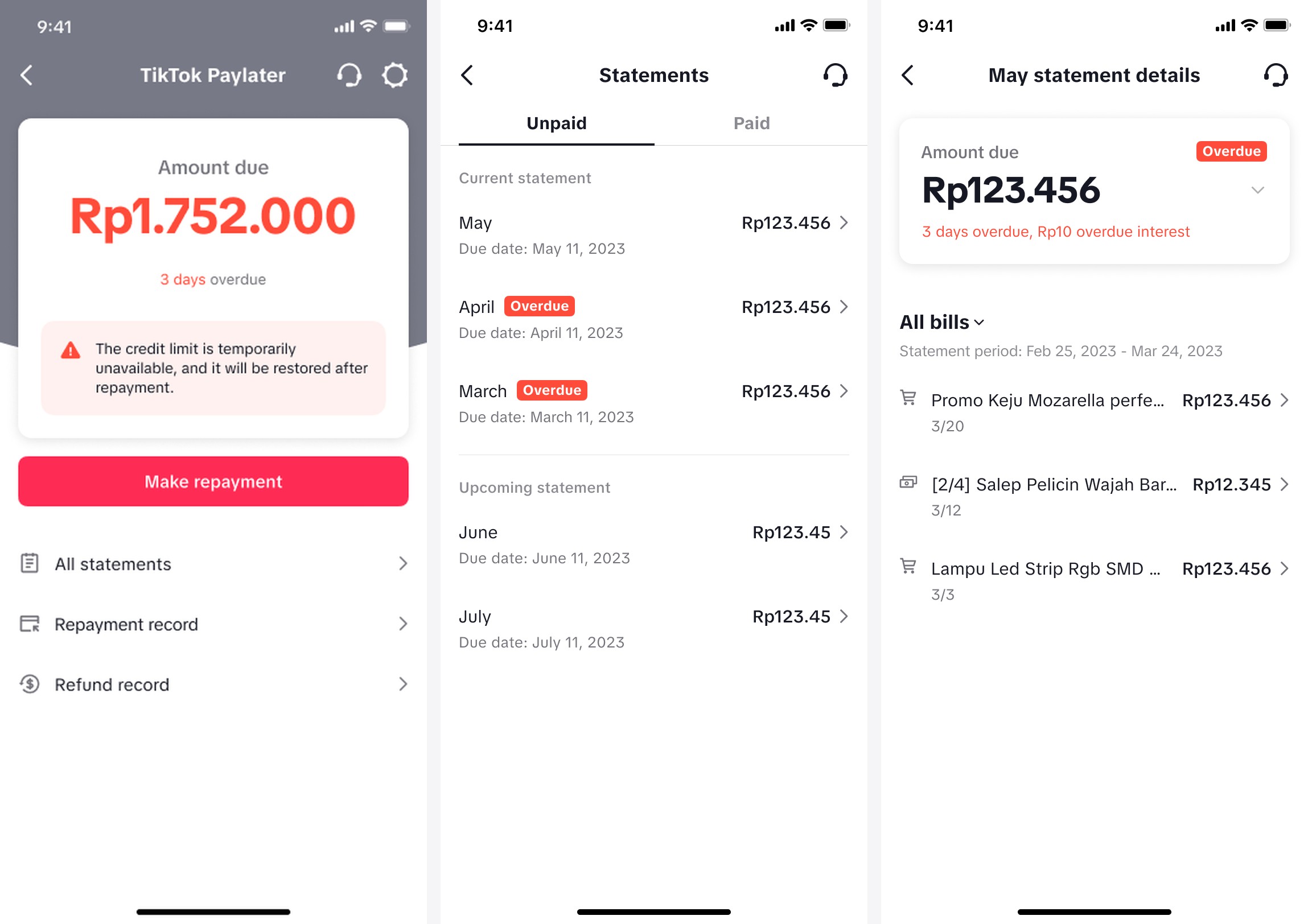
02 — Account & Billing: eight states, one homepage

02 — 账户账单:八种状态,一个首页

The account homepage is every return user's first screen. It needs to communicate the user's financial state clearly and drive the right action — across eight meaningfully different situations.

账户首页是每个回访用户的第一个画面。它需要在八种截然不同的状态下,清晰传达用户当前的财务状态并引导正确的行为。

Service Architecture 服务结构

The homepage was the engine of the broader account service map.

首页不是孤立页面,而是整套账户服务结构里的状态引擎。

It explained account status and routed users into the right bill, record, or self-service path.

它负责解释账户状态,并把用户送进正确的账单、记录或自助服务路径。

Bills 账单
Bill list
账单列表
Current / paid / future bills
当期 / 已还 / 未来账单
Bill detail
账单详情
Records 记录
Repayment records
还款记录
Refund records
退款记录
Self-service 自助服务
Settings / T&C / support
设置 / 条款 / 客服
State Logic
状态逻辑

8 homepage states came from 4 core dimensions.

8 个首页状态,本质上来自 4 条核心判断维度。

05

Risk exception is an overlay, not a normal lifecycle node. It can interrupt any returning-user homepage and override the default action.

账户异常不是普通生命周期里的一个节点,而是叠加在系统之上的覆盖维度,可能打断任意老用户首页并覆盖默认主动作。

No active bill
无活跃账单
Current-cycle debt
当期待处理欠款
Current cycle settled
当期已结清
User stage
用户阶段
Repayment urgency
还款紧迫度
Current-cycle bill
当期账单
Next-cycle spending
未来期消费
new
新用户
returning
老用户
01

No transaction yet

无消费记录

08

No usage this cycle

本期未使用

02

Outstanding

有欠款未逾期

03

Approaching due date

临近还款日

04

Overdue

已逾期

06

Settled + next bill

本期已还,未来期有消费

07

Settled + no next bill

本期已还,未来期无消费

Cluster A 分组 A
No active bill on the page
页面上没有活跃待还账单
01
New user
新用户

No transactions yet. The homepage behaves like a first-entry service hub.

无消费记录,首页更像首次进入的服务入口。

08
No usage this cycle
本期未使用

Returning user, but no repayment is needed in the current cycle.

老用户,但本期没有待还金额。

Cluster B 分组 B
Current-cycle debt still needs handling
当期欠款仍需处理
02
Outstanding, not overdue
有欠款未逾期

Normal repayment state with standard bill and entry points.

常规还款态,展示标准账单与还款入口。

03
Approaching due date
即将逾期

The same debt state, but with stronger urgency and reminder treatment.

同样是待还账单,但需要更强的到期提醒与催还表达。

04
Overdue
已逾期

Urgency peaks. The homepage shifts into recovery mode and credit can be frozen.

紧迫度最高,首页进入逾期恢复模式,并可能伴随额度冻结。

Cluster C 分组 C
Current cycle is settled
当期已结清
06
Repaid, future spending exists
本期已还,未来期有消费

The next bill is already forming, so the page remains financially active.

未来账单已形成,首页仍需保持“有账务上下文”的状态。

07
Repaid, no future spending
本期已还,未来期无消费

The account becomes quiet after settlement, even though the user is still returning.

结清后账户进入安静态,但用户仍然是回访用户。

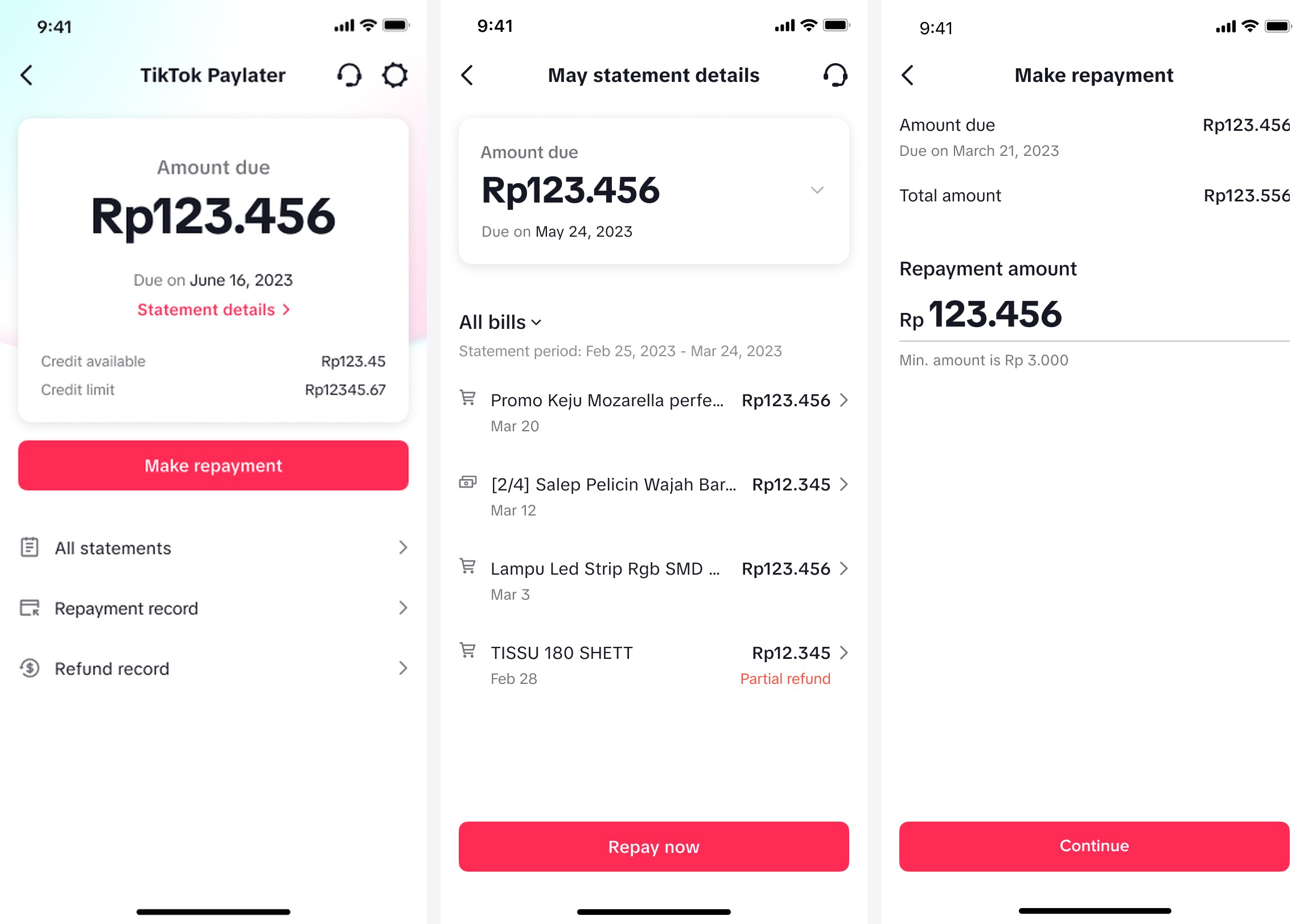
03 — Repayment: channel selection informed by real data

03 — 还款体验:用真实数据指导渠道优先级

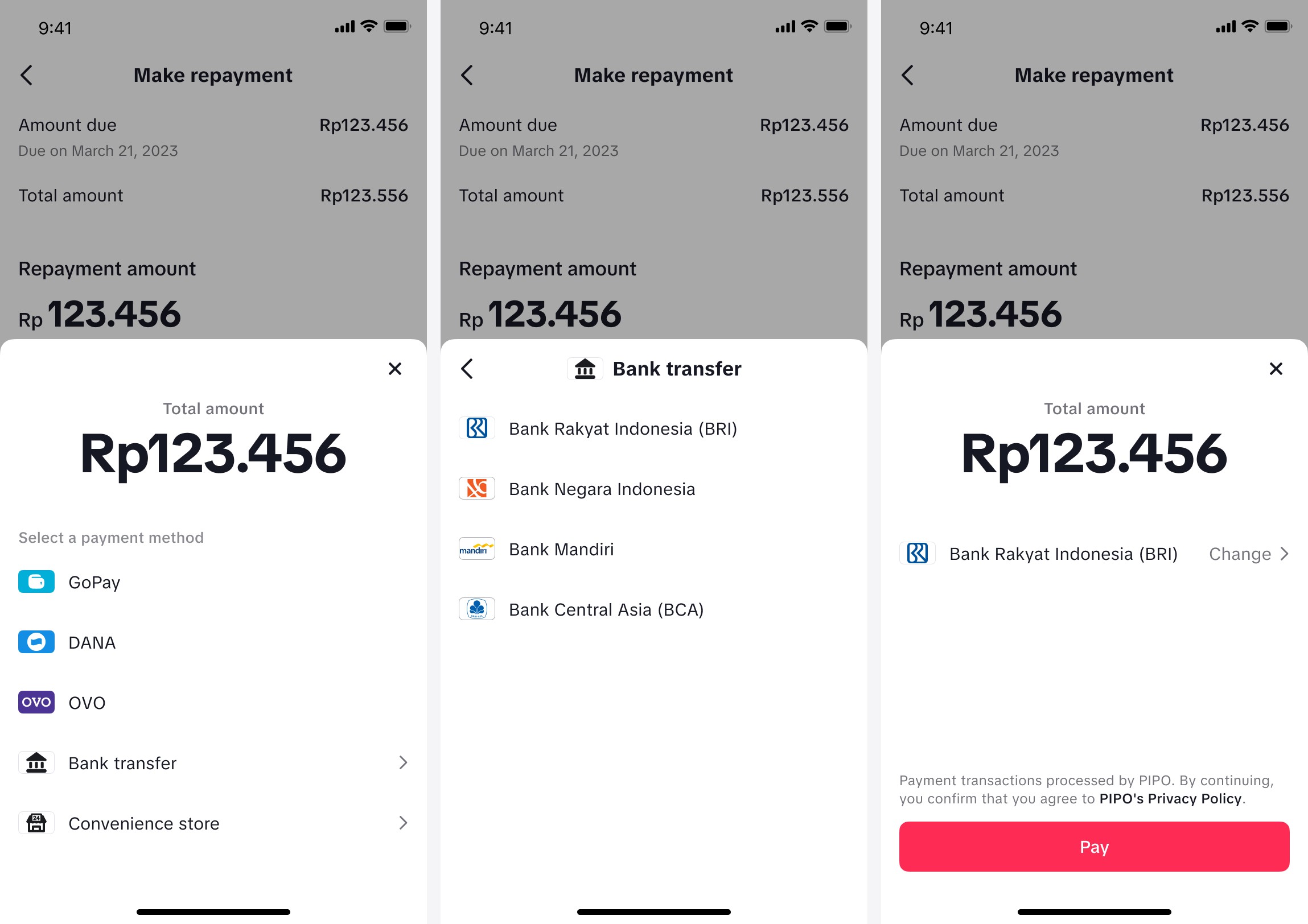
TikTok PayLater uses account-level repayment. I used internal PIPO payment performance data to rank channels by success rate — guiding users toward higher-probability payment paths.

TikTok PayLater 采用账户维度还款。我使用内部 PIPO 支付数据,按支付成功率对渠道进行排序,引导用户优先选择成功率更高的支付路径。

Repayment products split into bill-level and account-level models. Since TikTok PayLater is account-level repayment, I only benchmarked the same type. In this model, users need more than a successful payment moment — they need to know clearly what debt the money was applied to, whether the account balance actually changed, and whether ledger clearing is complete.

从产品能力上,可以分成账单维度还款和账户维度还款。TikTok PayLater 属于账户维度还款,所以我只参考同类型竞品。对这类产品来说,用户关心的不只是“钱付出去没有”,而是这笔钱到底还到了哪里、结清了哪部分欠款、账户状态是否真的更新,以及销账是否已经完成。

Bank Transfer
73.7%
success rate · 4.5M orders / 14 days
支付成功率 · 14天 450万笔
DANA
82.5%
success rate · 1.3M orders / 14 days
支付成功率 · 14天 130万笔
GoPay
67.8%
success rate · 910K orders / 14 days
支付成功率 · 14天 91万笔
OVO
82.6%
success rate · 367K orders / 14 days
支付成功率 · 14天 36.7万笔
Flow Orchestration 流程编排

Channel ranking was only one layer. The harder part was asynchronous repayment orchestration.

渠道排序只是表层,真正更难的是异步还款编排。

The real challenge was turning entry differences, external handoff, polling, and ledger confirmation into one trustworthy repayment journey.

真正难的不是渠道排序,而是把入口差异、外部跳转、结果轮询和销账确认,串成一条可被用户信任的还款旅程。

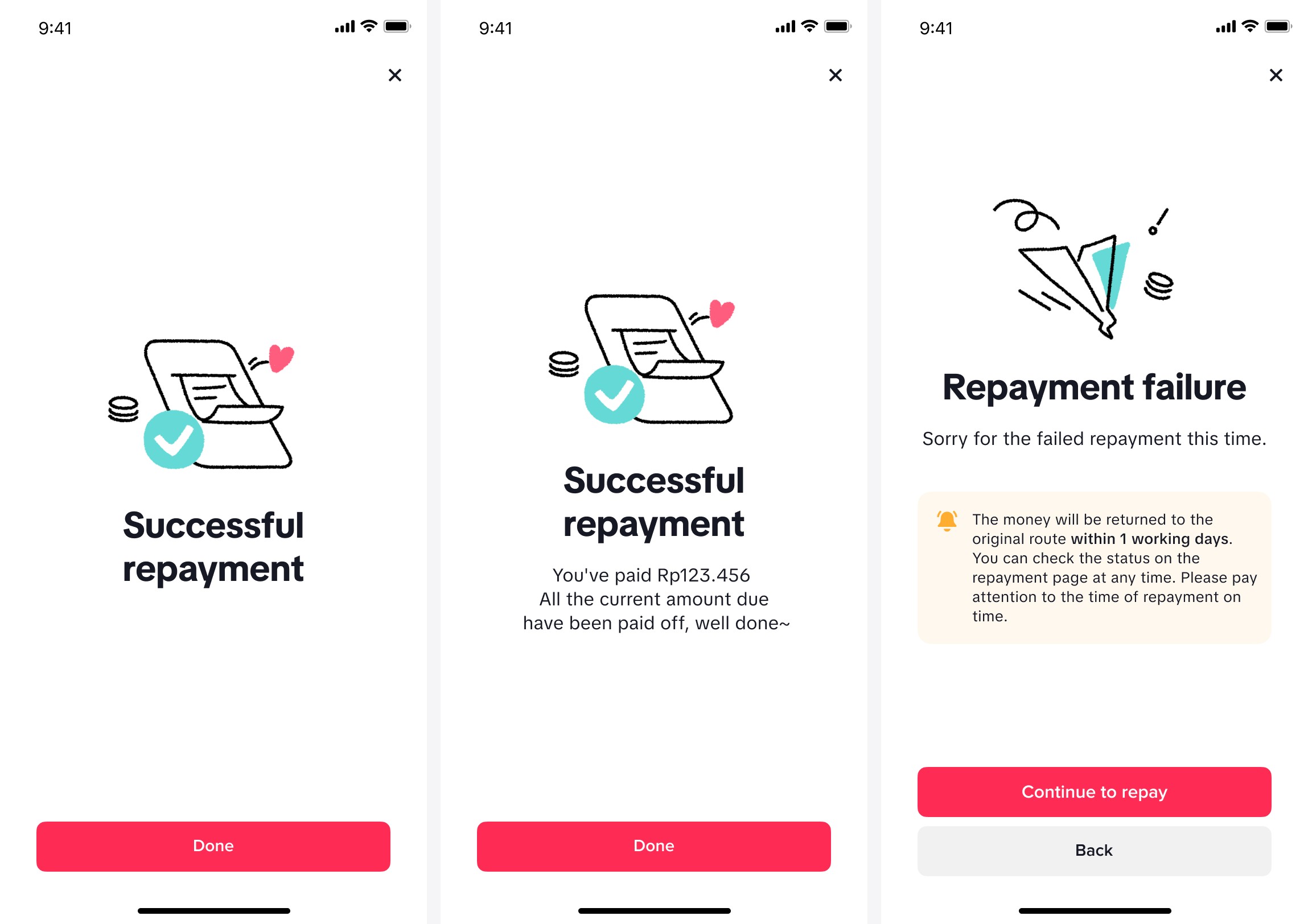
Because this is account-level repayment, the interface must answer one question clearly after payment: where did the money land? A payment can clear the current cycle while the account still carries other debt, so the result has to explain both this repayment and the remaining account status.

因为这是账户维度还款,支付完成后界面必须清楚回答一个问题:这笔钱到底还到哪里了。用户可能已经还清本期,但账户里仍有其他欠款,所以结果不仅要说明这次还款,也要同步说明账户剩余状态。

Repayment journey inside TikTok Shop TikTok Shop 内的还款旅程
Core path 主路径
Stage 01 阶段 01
Entry
进入
Stage 02 阶段 02
Amount confirm
金额确认
Stage 03 阶段 03
Channel pick
渠道选择
Stage 04 阶段 04
External cashier
外部收银台
Stage 05 阶段 05
Polling
结果轮询
Stage 06 阶段 06
Ledger clear
销账完成
New payer 新用户
Stage 03 → 04 extra path 阶段 03 → 04 额外路径 Needs channel setup first, adding one extra step before the same external payment handoff. 需要先配置渠道,因此在正式支付前会多一步额外配置。
Returning payer 老用户
Stage 02 → 03 fast path 阶段 02 → 03 快速路径 Bound channel lets users skip setup and move straight to confirm. 已绑定渠道可跳过设置,直接进入确认。
System state 系统状态
Stage 05 → 06 async gap 阶段 05 → 06 异步间隙 Payment ≠ ledger. Show pending / failed / success explicitly. 支付 ≠ 销账,必须明确展示 pending / failed / success。
OVO OVO proof path mapped to the same 6 stages OVO 实际路径,对应同一套六阶段结构
Stage 01 阶段 01

Pick OVO

选择 OVO

User opens cashier and selects the highest-success wallet.

用户拉起收银台,并选择成功率最高的钱包渠道。

TikTok repayment amount and payment method list with OVO available
Stage 02 阶段 02

Enter wallet number

输入 OVO 号码

Cashier confirms amount and asks for the OVO-linked phone number.

收银台确认金额,并要求输入绑定 OVO 的手机号。

OVO payment method selected with phone number input field
Stage 03 阶段 03

Prompt + notification

支付引导 + 系统通知

TikTok guides the user out, then waits for the OVO push notification.

TikTok 给出外跳引导,并等待 OVO 推送通知到达。

Prompt asking user to open OVO app and approve the payment
OVO confirmation notification banner shown over TikTok
Stage 04 阶段 04

Confirm inside OVO

在 OVO 内确认支付

User opens OVO and completes the payment inside the wallet app.

用户打开 OVO,在钱包 App 内完成确认与支付。

OVO payment confirmation screen inside the OVO app
OVO app payment success confirmation screen
Stage 05 阶段 05

Return + polling

返回 TikTok + 轮询

Back in TikTok, payment may be done while ledgering is still pending.

回到 TikTok 后,支付可能已完成,但销账仍在处理中。

TikTok waiting state while polling for repayment result
TikTok repayment processing screen while ledger result is still pending
Stage 06 阶段 06

Ledger result

销账结果

Show success only after ledger clear. If it fails, explain refund and unsettled account status.

只有销账完成后才能展示成功;如果失败,则需说明退款与未结清状态。

TikTok repayment failure screen after ledger clearing fails
TikTok successful repayment result screen after ledger confirmation
Risk Identification
体验风险识别

Surfacing problems before they become expensive

在问题变贵之前,主动把它们找出来

Beyond the flows, I maintained a live risk register — potential experience failures that wouldn't block launch but would generate friction or support volume at scale.

除了流程设计本身,我还维护了一份体验风险清单——这些问题不会阻止上线,但在规模化后会持续产生摩擦和客诉。

# Risk 风险 Module 模块 Plan 后续计划
01 Form length reduces credit application conversion 表单过长影响转化率 Credit 授信 Negotiate minimum required fields with all stakeholders 与各方协商精简必填字段
02 PIN forgetting — infrequent use, complex recovery PIN 易遗忘,找回流程复杂 Credit 授信 Introduce face recognition as alternative auth 引入人脸识别作为替代核身手段
03 Phone number and ID cannot be modified post-submission 手机号和证件信息提交后无法修改 Credit 授信 Prioritize edit capability based on support volume 根据客诉量排优先级增加修改能力
04 Jumio fails on iOS 14 (≈0.3% of Indonesian market) Jumio 在 iOS 14 上无法使用(印尼市场约 0.3%) Credit 授信 Evaluate alternative KYC vendors or in-house solution 评估其他 KYC 供应商或自研方案
05 Available credit limit not visually prominent 可用额度在视觉上不够显眼 Account 账户 Test alternative visual hierarchies in user testing 在用户测试中验证调整后的视觉层级
06 Insufficient bank options in repayment channel list 还款渠道中银行选项不足 Repayment 还款 Competitive audit of bank channel coverage 梳理和竞品的银行渠道覆盖对比

Why a risk register matters: In fast-moving product environments, reviews focus on what's shipping. Proactively naming post-launch risks — and attaching owners and timelines — converts invisible costs into decisions that can actually be made. It's the difference between firefighting and prevention.

为什么风险清单重要:在快速迭代的产品环境里,评审会议往往聚焦在即将上线的功能上。主动命名上线后的潜在风险,并为每条风险附上负责人和计划,是把隐性成本转化为可执行决策的关键——这是防患于未然和事后救火的本质区别。

Impact
项目结果

A product that shipped — and a partnership that scaled

产品上线,合作规模化

I left ByteDance before the July 2024 launch and no longer have access to internal metrics. Public signals confirm the commercial significance of what shipped.

我在 2024 年 7 月产品上线前已离职,无法获取内部运营数据。但以下公开信号印证了产品的商业价值。

+70%
GoTo's Financial Technology segment earnings growth, year-over-year in 2024
GoTo 金融科技业务收益同比增长(2024)
July 2024
ShopTokopedia BNPL goes live — the experience I designed
ShopTokopedia BNPL 正式上线 — 我设计的体验

The experience I designed ultimately shipped with ShopTokopedia BNPL. Public reporting also framed the launch as part of a deeper TikTok partnership and a broader expansion of financial services on the platform. Source

我设计的这套体验最终随 ShopTokopedia BNPL 正式上线。公开报道也将这次发布放进了深化 TikTok 合作、扩展平台金融服务的整体叙事里。 相关报道

Biggest learning: In cross-functional environments with regulatory constraints (OJK compliance), design decisions are rarely owned by designers alone. The most impactful skill I developed here was translating UX risks into business and compliance language — giving PMs, legal, and partner institutions a reason to prioritize the right things. Design without that translation often stays on the backlog.

最大收获:在有监管约束(OJK 合规)的跨职能环境中,设计决策很少由设计师单独拍板。我在这个项目里最有价值的成长,是学会了把用户体验风险翻译成业务和合规语言——让 PM、法务和合作机构都有理由把正确的事情优先排上日程。没有这种翻译能力,设计往往只是停留在 backlog 里。